Docket
Matters, documents and deadlines for small law firms
Docket is a practice management platform for small and mid-sized law firms. It is currently in development and not yet available to customers.
Firms below a certain size rarely have practice management software, because the products aimed at them are billing systems with a case list bolted on. The daily risk in a small firm is not mis-billing — it is a limitation period nobody diarised, or a filing that went out against the previous draft.
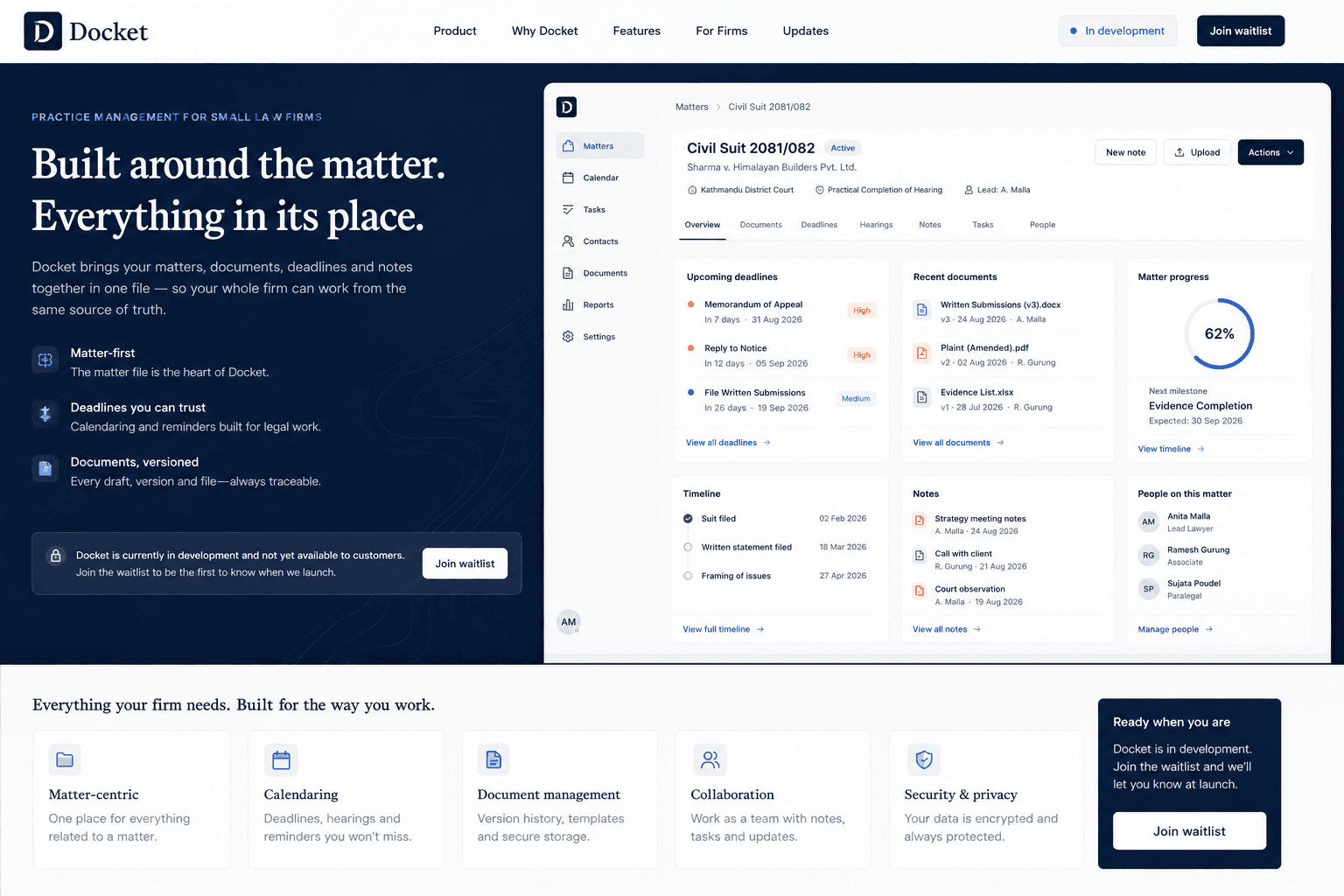
Docket is built around the matter file, with the document version history and the deadline calendar as first-class parts of it rather than attachments to it.
- Product type
- Legal practice management platform
- Industry
- Legal services
- Primary users
- Partners, associates, paralegals
- Status
- In development — design partners being onboarded
The problem
A small firm's case knowledge lives in one person's inbox, a shared drive with sixteen versions of the same agreement, and a wall calendar. It works until someone is on leave, a client asks what was agreed in March, or two people edit the same draft on the same afternoon.
- Deadlines tracked outside any system of record
- Document versions indistinguishable from one another
- Case history locked in individual inboxes
- Conflict checks done from memory
- Time recorded retrospectively, or not at all
- No view of matter profitability
The vision
The matter is the file, and the file is the system.
Everything in Docket hangs off the matter: parties, documents, correspondence, deadlines, hearings, notes, time and fees. Opening a matter should tell an associate who has never seen it what has happened and what happens next.
The second design principle is that a deadline is data, not a reminder. Limitation periods, filing dates and hearing dates are computed against the matter type and carried on the calendar with the rule that produced them attached.
What it does
- 01
Matter management
Matters opened against a client with type, parties, responsible fee earner, status and stage, giving the firm one list of what is actually live.
- 02
Document management and versioning
Documents stored against the matter with full version history, so the current draft is unambiguous and every earlier one remains retrievable with its author and date.
- 03
Deadline and hearing calendar
Key dates derived from matter type and jurisdiction, carried on a firm-wide calendar with escalating reminders and the rule that generated each date recorded alongside it.
- 04
Client and conflict checks
A searchable index of clients, parties and related entities checked at matter opening, with the result recorded on the file.
- 05
Time recording and billing
Time captured against the matter as work happens, with fee arrangements — hourly, fixed fee or retainer — reflected in what the client eventually sees.
- 06
Correspondence log
Emails, letters and attendance notes filed to the matter, so case history survives someone leaving the firm.
- 07
Document assistance
Drafting from firm templates with matter data merged in, plus summarisation of long documents and correspondence threads — with a fee earner reviewing every output before it leaves the building.
- 08
Matter profitability
Recorded time and disbursements set against fees billed, so the firm can see which work is worth taking on again.
Where it is up to
Docket is in development. This is what is built and what is next — kept current rather than aspirational.
Matters and documentsBuilt
Matter file, storage, version history and search
Deadline engineNext
Rule-derived key dates and firm calendar
Time and billingNext
Capture, fee arrangements and invoicing
Design partner rolloutNext
A small number of firms running live matters
General releaseNext
Open onboarding and jurisdiction packs
Docket is in active development, shaped with firms who deal with these problems daily. If your practice would make a good design partner, we would like to talk before the deadline engine is finalised.